
A planetary hours calendar, made for your city
Every planetary hour of 2027 on your desk, with the sunrise, the sunset and the Moon of each day. The hours change with the place and the season, so each edition is calculated for one city and checked to the minute.
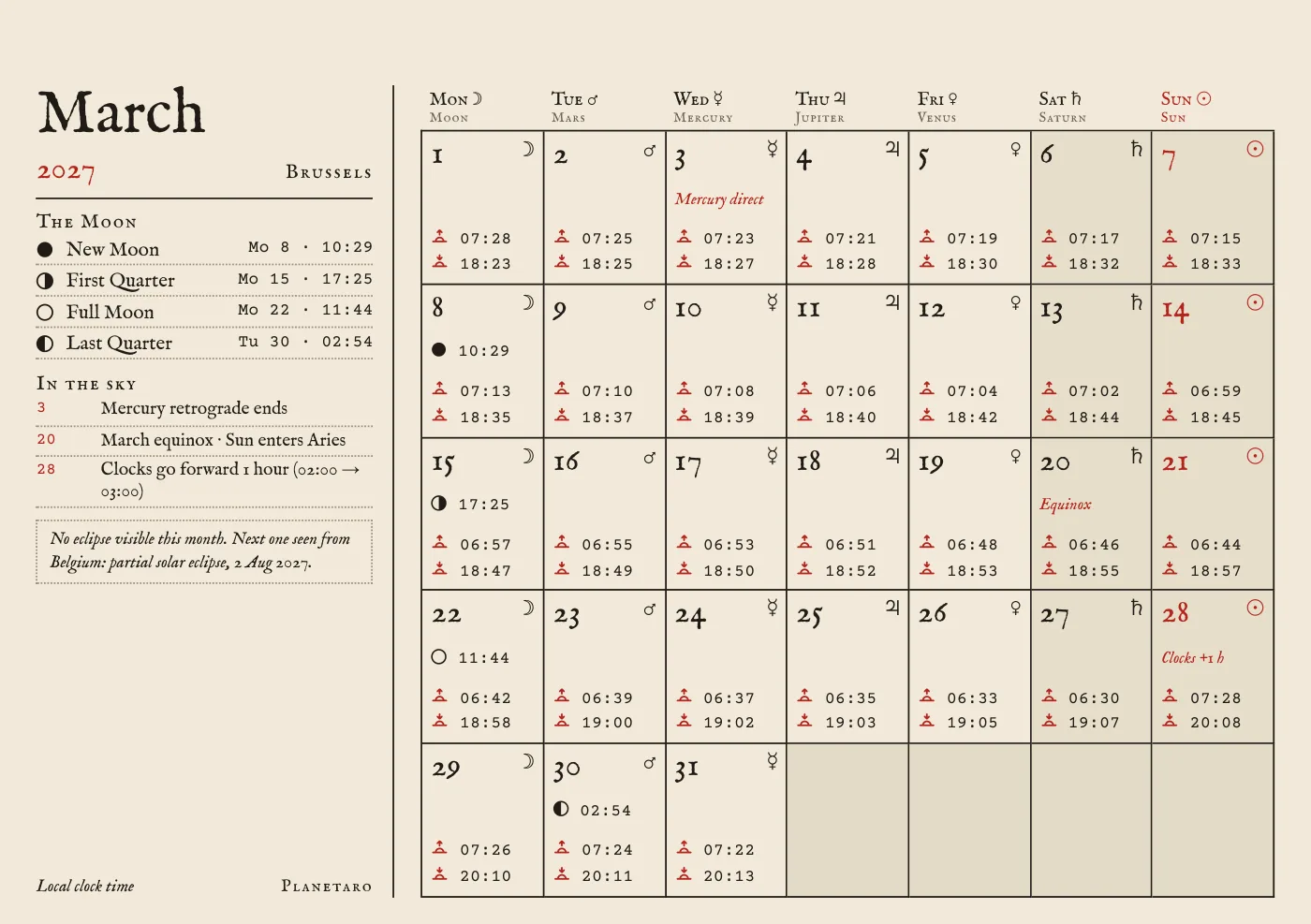
The front: your month in the sky
A calendar grid with the planet of each day, the sunrise and sunset, and the Moon phases to the minute. On the left, what happens that month: eclipses and how much of them you see from your city, meteor showers, the day the Sun changes sign, the days a planet turns retrograde or direct.
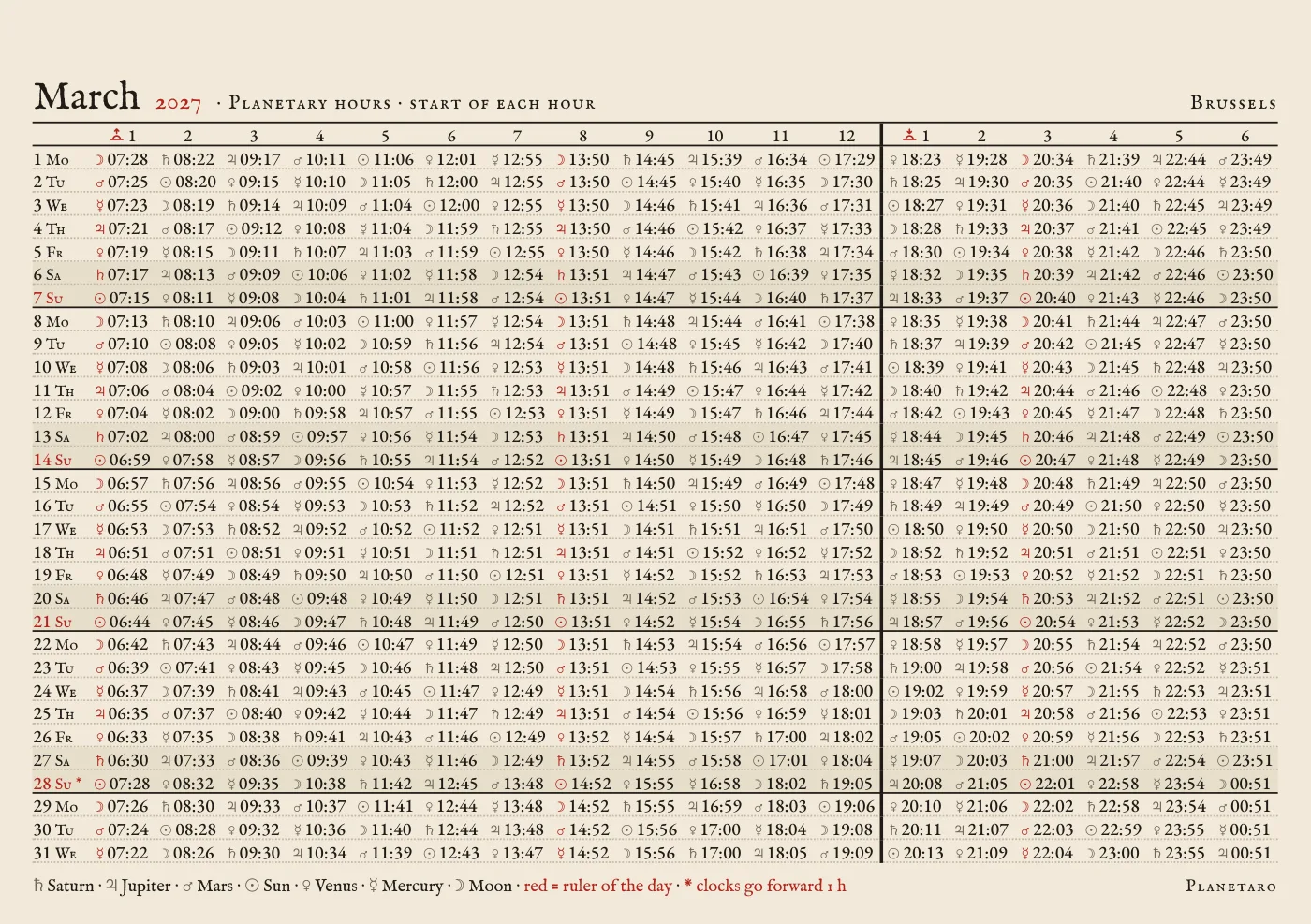
The back: every hour of every day
Turn the page over for the table: the twelve day hours and the first six night hours of each day, with the minute each one starts. The planet that rules the day is printed in red, so you find its hours at a glance.
On the desk
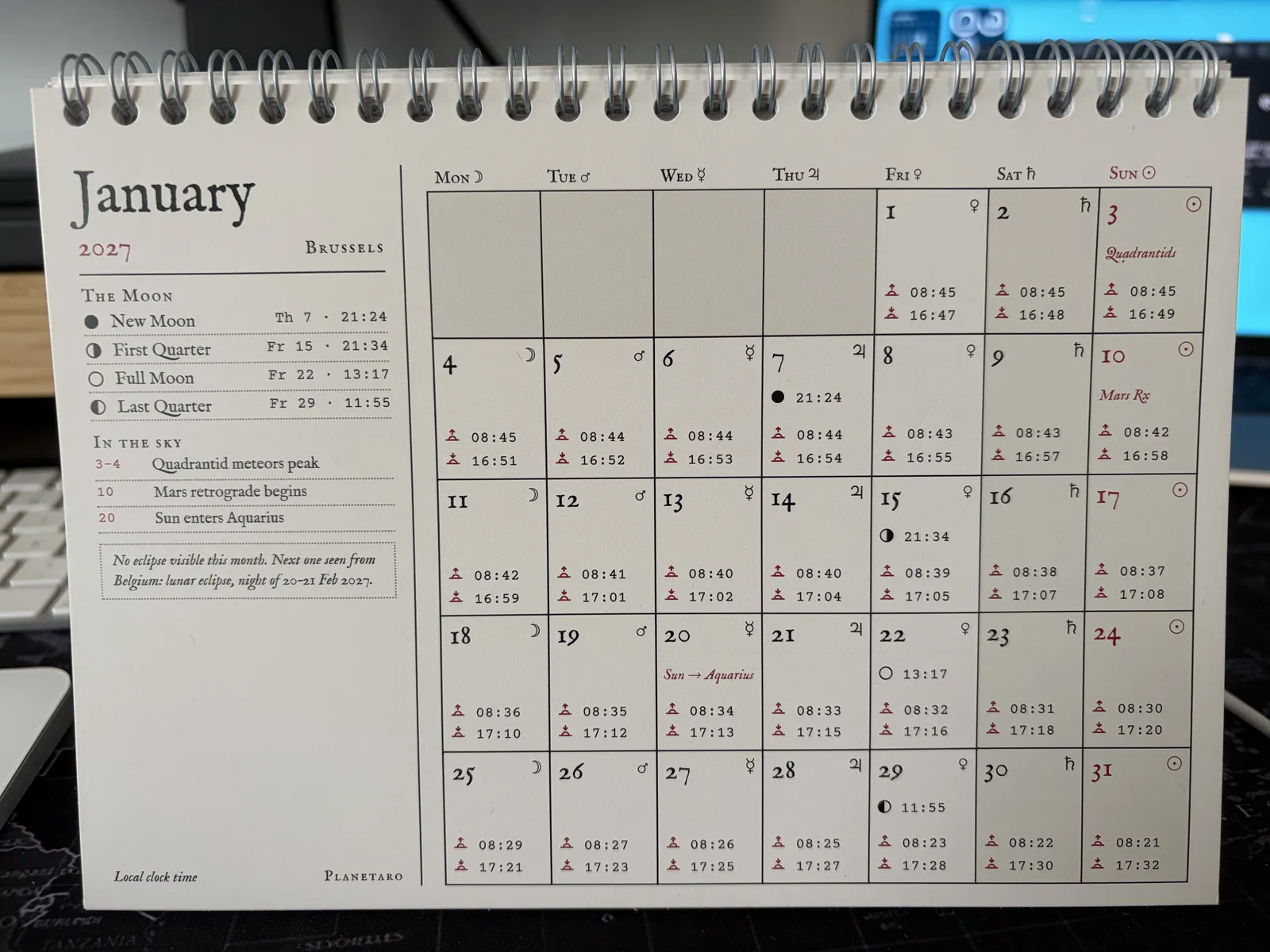
Photos of the first print run, Brussels Edition.


Editions for 2027
Printed in small runs. Join the waiting list for your city and we write to you once, when it is ready. Every edition has a table of the towns around the city, with the minutes to add or take off.
Europe
A5 landscape · ships within the EU and to the UK
- Amsterdam Join the waiting list
- Berlin Join the waiting list
- Brussels Join the waiting list
- London Join the waiting list
- Madrid Join the waiting list
- Paris Join the waiting list
United States
6.25 × 4.25 in · ships within the US
- New York Join the waiting list
- Los Angeles Join the waiting list
- Chicago Join the waiting list
- Houston Join the waiting list
- Atlanta Join the waiting list
- Washington Join the waiting list
Join the waiting list
Write your city, whether it is listed above or not. We print the cities that are asked for most. Leave your email and we write to you once, when your edition is ready. Nothing else.
Why a planetary hours calendar needs a city
In planetary time the day is not cut into 24 equal hours. The daylight, from sunrise to sunset, is divided into twelve day hours, and the night into twelve night hours. In June a day hour in Berlin lasts about 84 minutes; in December, about 38. Each hour belongs to one of the seven classical planets, in the old Chaldean order: Saturn, Jupiter, Mars, the Sun, Venus, Mercury, the Moon. The first hour after sunrise belongs to the planet of the day.
Because everything hangs on the sunrise and sunset, the hours in Madrid are not the hours in Amsterdam, and a general calendar can only give you the rule. The Almanac gives you the answer: the minute each hour starts, where you live, for every day of the year.
How the times are made
We calculate sunrise and sunset for the centre of each city with the method the US Naval Observatory uses, and then compare every single day of the year with the Observatory's own tables. The Moon phases come from the same source. Every hour start is checked again with an independent calculation, and the days the clocks change are marked in the tables. An edition goes to the printer only when all of it agrees.
Questions
Why is the calendar made for one city?
Planetary hours are not clock hours. The time from sunrise to sunset is split into twelve day hours, and the night into twelve more, so every hour starts at a different minute depending on where you are and what day it is. A calendar that prints those times can only be right for one place. Each edition has a table of the towns around the city, with the minutes to add or take off: in the New York Edition, for example, you add five minutes for Philadelphia.
How exact are the times?
Sunrise, sunset and the Moon phases are checked against the tables of the US Naval Observatory for every day of the year, and every hour start in the calendar is checked with a second calculation. Times are local clock time, with summer time, rounded to the nearest minute.
What is in the calendar?
Twelve months, January to December 2027, on 15 sheets printed on both sides. The front of each month is a calendar grid with sunrise and sunset for every day, the Moon phases to the minute, eclipses, meteor showers, the day the Sun changes sign and the days a planet turns retrograde or direct. The back is a table with the start of every planetary hour of every day. There is also a short guide to reading the hours and a page with the whole year in the sky.
How big is it?
The European editions are A5 landscape (21 × 15 cm) on heavy 350 g paper. The US editions are 6.25 × 4.25 inches. Both have a wire binding at the top and stand on their own cardboard base.
Which language is it in?
English. Most of the calendar is numbers and planet signs, so it reads easily in any country.
My city is not on the list. Can I get one?
Yes. Join the waiting list on this page and write your city. We make new editions for the cities that are asked for most, and if you leave your email we write to you once when yours is ready.
Where can I see the hours for today?
In the Planetaro app for iPhone and Android: the planetary hours of any day, for any place, with reminders. The calendar is the same data on paper for one city and one year.
The hours of today, live
The calendar shows one city for one year. The Planetaro app shows the planetary hours of any day, anywhere, with reminders and widgets.